Showing posts with label disaster. Show all posts

Tuesday, November 14, 2017

These Are My People

h/t Peter @ Bayou Renaissance Man
Vegas shooting ER team
Ironman, Captain America, Superman, and Batman 

From this month's Emergency Physician's Monthly (the trade paper for ER docs):

I’m a night shift doc. My work week is Friday to Monday, 8 p.m. to 6 a.m. Most people don’t want to work those shifts. But that’s when most of the action comes in, so that’s when I work. It was a Sunday night when the EMS telemetry call came in to alert Sunrise Hospital of a mass casualty incident. All hospitals in Las Vegas are notified in a MCI to prepare for incoming patients.
As I listened to the tele, there happened to be a police officer who was there for an unrelated incident. I saw him looking at his radio. I asked him, “Hey. Is this real?” and he said, “Yeah, man.” I ran down to my car and grabbed my police radio. The first thing that I heard when I turned it on to the area command was officers yelling, “Automatic fire…country music concert.” Ten o’clock at night at an open air concert, automatic fire into 10-20 thousand people or more in an open field—that’s a lot of people who could get hurt.
At that point, I put into action a plan that I had thought of beforehand. It might sound odd, but I had thought about these problems well ahead of time because of the way I always approached resuscitations:
  1. Preplan ahead
  2. Ask hard questions
  3. Figure out solutions
  4. Mentally rehearse plans so that when the problem arrives, you don’t have to jump over a mental hurdle since the solution is already worked out
It’s an open secret that Las Vegas is a big target because of its large crowds. For years I had been planning how I would handle a MCI, but I rarely shared it because people might think I was crazy.

It's written by the senior ER doc on duty, and so from his perspective. Taking not one thing from him, but the reality is, while his plan helped, it was a team effort.

For instance, they had 6 ER docs working that night, including a Trauma surgeon and Trauma resident.
We also initiated our hospital’s “code triage,” in which staff from upstairs would come down to help by bringing down gurneys and spare manpower. We took all of our empty ED beds and wheelchairs out into the ambulance bay. Anybody who could push a patient, from environmental services to EKG techs to CNAs, came out to the ambulance bay. I said to the staff, “I’ll call it out. I’ll tell you guys where to go, and you guys bring these people in.”
Unstated were how many RNs on hand, but in a 36-bed main ER, they had 10+, which swelled to probably 20-50.
What were they doing?

 At that point, one of the nurses came running out into the ambulance bay and just yelled, “Menes! You need to get inside! They’re getting behind!” I turned to Deb Bowerman, the RN who had been with me triaging and said, “You saw what I’ve been doing. Put these people in the right places.” She said, “I got it.”
And so I turned triage over to a nurse. The textbook says that triage should be run by the most experienced doctor, but at that point what else could we do?
Better late than never, doc. Nurses run Triage 24/7/365 everywhere. Should've seen that coming and made the call a lot faster.
We were in the hallway of Station 1 with the beds side by side. We were butt to butt intubating these three people. “I need etomidate! I need sux!”
Up until then, the nurses would go over to the Pyxis, put their finger on the scanner, and we would wait. Right then, I realized a flow issue. I needed these medications now. I turned to our ED pharmacist and asked for every vial of etomidate and succinylcholine in the hospital. I told one of the trauma nurses that we need every unit of O negative up here now. The blood bank gave us every unit they had. In order to increase the flow through the resuscitation process, nurses had Etomidate, Succinylcholine, and units of O-negative blood in their pockets or nearby.
Another good call. But "Duh".
By this time, all the patients had bilateral IVs. As the orange tags and yellow tags would become red tags, it became very apparent that those early IVs, put in while patients still had decent veins, were lifesaving. As the patients decompensated, we had adequate access to rapidly transfuse and stabilize patients. If we didn’t have that early IV access, we would have spent valuable time trying to cannulate flat veins.
Putting in IVs: nursing skill. Twenty-forty/night. That's why all those patients magically had bilateral IVs.
Cannulating flat veins: what ER docs do when patients don't have anything better.
So again, "Duh."
Throughout the night, I would look up from what I was doing and scan the room to see if anyone was crumping. I noticed a choke point forming for CT. We were now left with stable yellow tags. These patients needed CAT Scans. Typically, the CT Tech picks up the patient, transfers them onto the scanner, and then they bring the patient back. These yellow tag patients were shot in the torso, but for some reason were stable even after 2 or 3 hours. I told the CT Tech, go over to the CAT scan machine, and sit behind the controls. “I don’t want you to move. You’re just going to press buttons for the rest of the night.” Then I took every nurse that was free—at that point we had a lot of extra staff—and told them that all the people who needed CAT scans needed to be lined up in the ambulance hallway outside of CAT scan. We placed monitors on them, and nurses watched them. Then the nurses assisted getting each patient on and off the CT, and then back over to Stations 2 and 4. I called it the CT Conga Line.
And yet again: Good improvisation, excellent use of resources, poor foresight.
But how many hospitals deal with 250 GSWs in 6 hours? So far, just this one.
I identified another choke point with the green tag patients. Many were shot in the extremities. They had potential fractures or open fractures and needed X-rays. The standard way of doing things is taking the patient for an X-Ray, then sending it off to the radiologist so they can read it in their reading room. That was just going to take too long. So I told our CEO, Todd Sklamberg, “I need a radiologist here in the ER. I’m going to attach him to an X-Ray tech because our machines have little screens on them.” They X-Rayed patients, the radiologist read off the screen, and we would decide on disposition right there.
Another genius move. Put the people where the work is, and roll the patients past them.
Create flow; eliminate the bottlenecks, choke points, and single-points-of-failure.
IOW, destroy almost everything we do now, to do what you have to do then.
In the end, we officially had 215 penetrating gunshot wounds, but the actual number is much higher. As I would circle the ER “looking for blood,” I would hear the green tags say, “You know what? I’m not that bad—I’ll be fine.” Over time, they would walk out without getting registered. Our true number was well over 250.
The surgery team performed an unprecedented feat that night. The numbers speak for themselves. In six hours, they did 28 damage control surgeries and 67 surgeries in the first 24 hours. We had dispositioned almost all 215 patients by about 5 o’clock in the morning, just a little more than seven hours after the ordeal began. That’s about 30 GSWs per hour. I couldn’t believe that we saved that many people in that short amount of time. It’s a testament to how amazingly well the hospital team worked together that night. We did everything we could.

Improvisation: 10
Pre-planning: 5
Success: 9.9

Takeaway: Plans fail. So does planning. People - who can improvise on the spot - save your ass. And in this case, 200+ patients too.
Top to bottom, these folks were rockstars, when it counted.

Hopefully some of the two dozen nurses and hordes of other staff members will be telling their stories from that night, especially for lessons learned from all the other perspectives.

Superpowers, bitchez.
F**k a cape and tights; superheroes wear scrubs and stethoscopes.
And they kick Death's ass.


Thursday, August 27, 2015

Trauma Is Never Pretty

I've been working trauma cases professionally since the early 1990s. (Before that was simply happenstance.) And while all trauma is the same after the first 500 times, no two are ever exactly alike.

Something you have to know, in a way most of you hopefully will never learn from bitter experience, is that some wounds are non-fixable. Whether you're working with a victim of a car accident or someone attacked by a mob, or simply one dedicated assailant, you have to know going in that you will not fix certain things, and that in many cases, no one can.
Not even if the injury in question happened inside a trauma surgical suite, with the doctors and team prepped and ready to go, even if you had 20 units of O-negative blood hanging ready to transfuse.

HIPPA and concern for a certain family prevent me from getting detailed at this point.
But suffice it to say that sometimes, a gunshot or blade will create more damage than can be fixed, and that person is simply going to die, rapidly.

There's a scene at the beginning of the plane crash in The Grey, when Liam Neeson's character is surveying the injured and dead, and he finds a guy with traumatic abdominal bleeding, and he tells the man, in his final moments, that yes, he is indeed going to die, right there, and rather quickly, which he then proceeds to do on screen.

That was truth: it works just like that in the real world too. When someone pumps out all their lifeblood in ten or twenty pumps, like they will, that's it. Getting an IV won't work, you aren't going to cut them open and crossclamp their aorta, and an IV or five isn't going to save them, because there's no hemoglobin in normal saline.

That means you can start IVs, even IO lines (that's an IV in your bones for the laymen in the audience), and pump in liter after liter of fluid, even with whole blood, and it ain't gonna do anything but come out the hole(s) you can't fix. And run all over the place outside. They'll still get no oxygen in their vital organs, and they'll simply be warm and dead and white as a ghost when you're finished, and that truth is ordained before you ever lay hands on your patient.

That's going to be true in a disaster, or even a trauma unit. In the latter, you do every damned thing you can, especially on a young healthy victim, because they have the best chance. Best being relative when the absolute odds are close to absolutely zero.

In a disaster or worse scenario, you aren't going to - and probably shouldn't - do all that. At that point, you're simply wasting precious supplies to feel better about someone dying that you couldn't save. Which is both wasteful and unwise.

God help you and your conscience if you haven't wrapped your head around that reality long before the day you get there. Even knowing the truth, the moments will hang around in your head for a good long time.

If you're going to do this, yeah, you save the ones you can.
But you have to know in your bones that there will be plenty you can't save, and you have to let them go. Physically, mentally, and emotionally.

And I can't even begin to tell someone how to do that when it's someone you know, or care for deeply.

Saturday, November 8, 2014

Home Water Storage


This is not exhaustive, obviously, but it's a handy overview. The full range of options are as unlimited as your own imagination and inventiveness, provide you think about all the aspects regarding weight, bulk, safety, accessibility, and cleanliness of the supply.
From bottom-end to top, some choices to get you thinking:
G.I. 1-quart plastic canteen.
Water for 6 hours or so. $5-10.
GI 5-gallon plastic water jug.
Water for 5 days for 1 person. $35-50.
Aqua-tainer 7 gallon water jug.
Water for a week for 1. About $20.
Water Bob 100-gallon bathtub water storage bag.
Water for 3 months. $30.
Food grade 55-gallon water barrel.
Water for 2 months or so. $75-ish. (Shop around. You can do better than this. Also, some opportunistic jackholes are asking $175 and more for the same thing. If you're willing to pay over 2 times market price, go to the tattoo parlor and have "SUCKER" emblazoned on your forehead.)
IBC 330-gallon caged palletized water tank.
Water for nearly a year for 1. Over $500 new, plus shipping.
Used ones can be had; make sure they were used for water, and not something like vinegar, or some toxic chemical. This is why IMHO, new is your friend unless you're a careful customer. Also nota bene the filled weight is nearly a ton. This mixes with stick-built upper floors in apartments rather poorly, especially in seismically active areas, but it will help you meet the downstairs neighbors. And their insurance adjuster.
OTOH, if you mount one on 3/4-5/4 plywood set on top of two levels of cinder blocks in a ground level garage or other concrete slab, the drain spigot will be handily elevated to fill smaller jugs and buckets. If you mount one or several in series at elevation, and plumb them to the home system, you can create low water pressure to supply whatever.
 
Above-ground pool.
Various sizes. This one holds 425 gallons, and goes for $57 @ Wal-Mart.

You could get an 18' diameter x 52" tall metal-walled monster that holds 7700 gallons (a year's drinking water for 20 people) for a bit over $900.
Even bigger models are available. BTW, the best time to buy is now, with retailers and manufacturers sitting on last summer's leftovers, and sales prices in full effect.
Notes: if you can put it up inside a garage and put the cars outside, it's secure, and on a stable and accessible surface spot. You'd want to cover it, still be best off by purifying/filtering the water before drinking or cooking, and want to sandbag or build some diverters in case of leakage or failure. But you could cook and drink for years, and have enough left over to wash a set of clothes in a bucket once a week, and then use the after-wash to occasionally flush a plumbed toilet, even in a multi-level condo with garage in the 'burbs. Obviously, you wouldn't be able to leave it set up perpetually, but in a pinch, with between a couple of hours to a day, you could fill it up while the muni taps are still running. Think about that.

There are obviously even larger storage options, including in-ground pools and water tanks. As you approach that point, and get into the means to fill/recharge them manually or naturally, you're getting more into water sources than water storage.

Which I'll visit another time.

Thursday, November 6, 2014

Water, Redux


This topic is here, since it's a thing people are concerned about, not just for a pandemic, but in general, since I did a general post way back when.
But for another whack at it, read on.

First off, you need a water source. Canteen, jug, well, cistern, pond, lake/river/stream, stored rainwater, snowmelt, whatever.

Second, you need a minimum of a gallon/person/day, just for drinking and cooking for survival. With heavy work (like filling sandbags) in hot weather that can climb to 3-5 gallons/person/day. A co-worker did a reserve activation to Iraq when the range was live in both directions, and part of that was acclimating in a camp in Saudi Arabia/Kuwait (I forget which, doesn't matter). The point was, in 120-degree weather, he described drinking so much water daily to keep up with physiological requirements his throat hurt from all the swallowing. He was a Navy corpsman, and what he really wanted to do was to stick two large-bore IVs in his elbows and hang saline bags wide open, as opposed to waking up at 3 AM feeling like a dry sponge, and pounding out cramps in his thigh muscles from electrolyte losses. Water is a big deal, and a gallon a day is just a guideline. Adjust as necessary.

Third, at some point, having enough to wash your hands and face, shower all over occasionally, and wash clothes is going to become not just a convenience, but a health issue. Mentally make some plans there too.

Once you've figured out where you'll get it, you need to make it clean.

Some options to consider:

A. Solar distillation
In a survival situation, you can always try a solar still:
It works, but.
In a desert survival situation, dig them at night. Doing so in the daytime will cost you more in sweat than you'll get back in drinking water. And you'll need more than one, because they don't get you much. You'd also want to make provision to recycle your urine output, and let the sun turn it back into just water. (Hey, it worked for the astronauts.)
But where this technique is better suited is purpose-built fixed solar stills.

That assumes you have the raw materials to make one. Or ten.
Wooden box, angled glass top, water pan inside, and drain tube to a 5 gallon bottle. Just remember that the germs you're filtering out now live inside the beginning pan. Clean it with a bleach solution from time to time. But if you had germ-filled water in abundance, and even a moderately sunny day, a few of those would keep you in water indefinitely, and you could build as many as you needed for your family/tribe.

B. SODIS
SODIS stands for solar disinfection. Simply put: load up a clear 1-liter water bottle. Put it in the sun all day. Tomorrow, it's drinkable.
You'll need two days worth of bottles, minimum. (one to drink from today, and one to be sunning for tomorrow's consumption). And sunny days, and warm weather. This won't work in Alaska in winter. For about 80% of the earth's surface, on sunny days, it will. But it requires the ability to leave your water out all day (6 hours minimum kills most everything) unattended. It's become the norm in most of the third world where clean drinking water doesn't exist. It's one of those tree-hugging Peace Corps ideas that works, as long as the sun and plastic bottles hold out.
Nota bene that a 1-liter, maybe 2-, is about the most this will work for. Larger thicknesses mitigate the sun's UV (which is what kills the nasties) too much to work 100%, and you'll get sick. It also doesn't work with tinted/colored bottles, for the same reason.
 
C. Chemical disinfection
1) Clorox or generic bleach (sodium hypochlorite) is fine. What you want is standard 6.025% plain-jane, unscented, no additives or other foofery, household bleach. 2 drops quart/8 drops per gallon (get an eyedropper!) for clear water, double that for cloudy water, and/or when it's cold (say below 50F) outside. Put it in, swirl/slosh it around, wait 30 minutes, and you have drinking water.
But household bleach has a shelf life. For 6 months, it's fine. But it loses 20% effectiveness after a year. (So add 20% more bleach if you're using a year-old jug). At five years, it's not bleach; it's just water. (Really nasty undrinkable water, BTW.) But the important point is, it isn't bleach either.
If you want a fresh batch, mix your own. Get Pool Shock. read the label, and make sure you're getting the mixture that contains only sodium hypochlorite. Nothing else.
Then do the math to make yourself a fresh batch of 6% by mixing that amount in the proper proportion of water. Now you've got a new bleach batch. (It's basic chemistry. Look it up yourself, and get it right. If you can't figure out how, you shouldn't be playing with it.)
Ready or home-made, light and heat speeds its decay. Store it in a cool, dark place in a lightproof bottle. If you're mixing your own, do it in small batches, and write the mix date on the bottle. If in doubt, pitch it out, and mix a fresh batch. And date it.
Bleach, and Pool Shock, are both corrosive. Store them in original containers, away from other items. Pool Shock will corrode metal containers left nearby or in contact. So storing
a bag of it in a heavy plastic tote, all by itself, in a brick or concrete bin inside, all by itself, would be a lot smarter that putting it in a metal locker in the sun with a loot of other things.
Ignore this at your own peril.
2) Potassium permagnate (KMnO4) is another chemical that will work, and is recommended in truly splendid survival manuals like Lofty Wiseman's SAS Survival Handbook. (The book is the real deal, and you should get a copy.) It's stocked as a water filtration chemical at places like Lowe's. In weak doses, it'll purify water. Stronger solutions can be used to clean wounds. And it can also be used as an expedient survival firestarter in combination with glycerin (a fact known to both arsonists, and arson detectives). It requires careful storage, and due diligence in handling and use.
3) Iodine crystals
If you aren't allergic to iodine (or shellfish, which usually indicates an iodine allergy),
The Polar Pure water disinfection solution is the best $20 you'll ever spend. Inside the bottle are iodine crystals. You pour water (clean, dirty, doesn't matter) into the Polar Pure. This makes an iodine solution. You pour that into the appropriate 1-quart/liter-sized container, wait the specified time, and presto!, the water is chemically disinfected. Germs are dead. The crystals stay inside the mix bottle; only enough iodine leaches into the water to do what you need each time. You can use the thing for 2000 times, 500 gallons worth, over 1 1/2 years for one gallon/person/day. Simple, bomb-proof, effective. The bottle is the size of a Tylenol bottle. The crystals sit there just fine, with a shelf life of functionally indefinitely.
 
D) Mechanical filtration
Using either a small, portable filter, like the Katadyn Pocket Microfilter
or any similar ones, you simply pump the dodgy water through an extremely fine (0.2 micron, for the Katadyn one) ceramic filter; crap in, pure H2O out. Check filter size, and usable life. I'm partial to the Katadyn because 0.2 microns gets everything, bacteria, viruses, and cysts like giardia, and also because it lasts for 50,000 liters/13,000 gallons. If it gets clogged, you unscrew the filter element, wash it off in clean water, and scrub it with the provided brush, and it's back in action. It's pricier than others, but it works, and lasts a lot longer. When you get quality gear, buy once, cry once is the rule. Filters like this are great because if there's water, albeit non-potable, you only need to carry the filter to make more; it takes a couple of minutes to fill a water bottle/canteen.
Smaller, less robust/long-lasting solution also work, all the way down to Lifestraw type of filters.
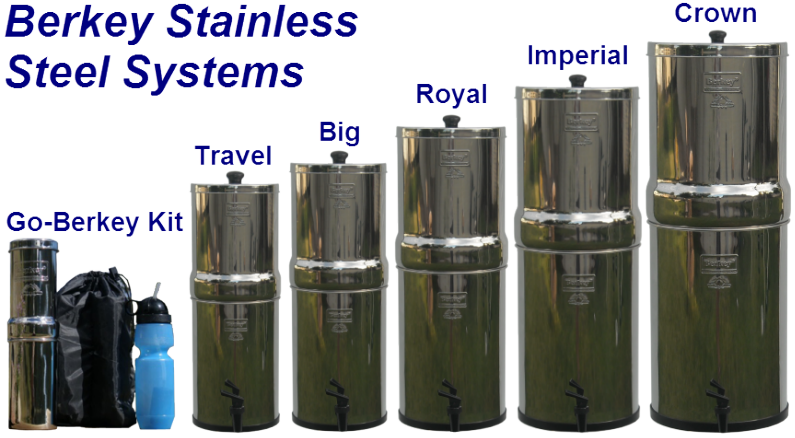
For more permanent installations, something like one of the Berkey Water Filters below is
 
the way to go. Depending on the size, they work with between 2 and up to 8 filter elements, and will do 2.5-6 gallons at a go. Pour dirty water in the top tank, it percolates to the clean holding tank at the bottom. Avoid their plastic models (they have issues); the stainless ones are just the thing for a home or base camp set up.
Both the Katadyn and Berkey line filter elements are replaceable, so getting spare elements is like having a spare tire or two for the car - gets you back in action for less than the price of an entire second car.
There are other brands as well, or you can home-make some from a food-grade bucket and ceramic filter elements, and they all do the same sort of job.
 
E) UV inactivation
The same thing SODIS uses the sun for, you can use UV light for. You can get fancy dedicated home set-ups (better know what you're doing, and know a water treatment UV expert to set you up). For smaller quantities on the go, there's nothing handier than the Steri-Pen UV water purifier.
 
Stick it in a liter/quart of water, turn it on, wait 90 seconds, and the critters you're worried about have been sterilized. Which means that they can't reproduce in you, so you don't get Traveler's Curse, AKA the Tijuana Two-Step (because you've got two steps to get to the commode). A set of lithium batteries will do 100 liters (25 gallons). You can replace the batteries, and use the bulb for 3000 liters (750 gallons). They sell other models, with more or fewer doodads and accessories, but they all work the same way. This is the same thing that SODIS does with sunlight, but in a minute and a half instead of 6 hours, and the sun is free, whereas the Steri-Pen goes for $40-80 bucks, and works at night, in a cave underground, as long as your batteries hold out and you don't break it.
 
F) Boiling
Q.: How do nuns make holy water?
A.: They boil the hell out of it.
Q.: How do you make drinking water out of dirty water?
A.: The same recipe.
The same thing works to kill the critters in any questionable water.
I mention it last, because it's time and fuel intensive. But it works every time.
Water in pot, pot on heat source, boil water, let cool, pour back and forth to replace dissolved O2 so it doesn't taste flat, drink. You've now passed Day One of Home Economics, and are smarter than all doctors before Louis Pasteur's Germ Theory became well-accepted.
Needs: a cooking pot, sufficient fuel/heat, and time. It takes longer at altitude than it does at sea level. Science is involved. Feel free to read up on that if so inclined.
 
The above methods are arranged from easiest/cheapest, to spendiest/most-resource intensive. Some are better for portability, some shine because they require noting much but waiting.
 
Of the above, solar distillation will remove some chemical contamination. (You'd want to read up on that before you stake your life on it.) The other methods will not.
Solar distillation and mechanical filtration will remove things like fallout particles. The other methods will not. And if you don't have a Geiger counter to check afterwards, you probably shouldn't be trying that anyway.
 
THINGS THAT DON'T WORK, AND WILL KILL YOU
 
1) Cousin Jed's homemade water filter:
 
What this WON'T do is remove the microscopic contaminating material reliably, because over time, that stuff builds up, the charcoal gets saturated, and there's no way to tell when it will fail/has failed, until everyone gets sick. Including you. Perhaps the very first time you use it if you were sloppy in constructing it. Then everyone dies from bacteriological contamination, and dehydration from bad water, and the resulting vomiting and diarrhea. Bad juju for you. Don't be that guy.
 
There is a silver lining though:
You can make one of these to strain murky water through, and clarify it substantially, which reduces the effort for UV, mechanical filtration, and chemical sterilization considerably.
So
a) yes, make one, but
b) remember that what comes out is still colonized with bacteria and smaller things, and your eyes can't see that small, so remember that the output is still contaminated.
Run your cruddy/murky/smelly water through that, and then use one of the other primary methods on the clarified but still non-potable output.
 
2) Brita et al tabletop filters
Those are strictly to make nasty tap water taste and smell better. They do not remove any of the critters that will harm you.
Silver lining:
But they can help get the chemical aftertaste out of purified water:
 
That's because some of the proper methods, esp. chemical, will leave some after-taste. This goes away with time, if you have the place to store clean water while that dissipates, without letting new contaminants in. Or you can run your chemically treated water through a taste filter once enough time has passed for the chemicals to have first killed the harmful stuff. 
 
A prudent course would be to be able/prepared to do more than one of the above methods, if not all of them; at least a couple/three.
 
Another time, we'll talk about sources and storage.


Monday, October 27, 2014

Crunching Numbers


So, tiring of the Usual Gang Of Idiots screwing up everything they can with both malignant incompetence and depraved indifference, I thought I'd look at the updated numbers on the primary outbreak in West Africa (Guinea, Sierra Leone, Liberia, and momentarily, Mali) for a little mental respite.

The numbers are quite simply bollocks.
The consistency is their inconsistency, which is what happens when you depend on the honesty, intelligence, literacy and numeracy of countries where a flush toilet is an object of suspicion and wonder, and books are for kindling fires.

Liberia regularly skips entire weeks, getting their numbers to WHO on the local equivalent of "Island Time": "It gonna git dere when it get dere, brah."
And that's before it embarrasses some oafficial (not a typo), or inconveniences a family with an extra chicken for bribing whoever's filling out the death certificates today, or someone waves their arms and yells "customary burial rituals". (And here you thought Diversity was only a PITA in the U.S. of A.)

The rule of thumb has been that the actual tally of infected and dead is 2-2.5 (and lately they're saying more like 3 a  lot) times the number of "official" cases of Ebola.

Looking at the case expansion rates since September 1st, both overall and by countries, the actual modifier should be between two and eleventy. Any other attempt at precision, or claims of same, is a cross between monkeys throwing darts at a graph, and witchdoctors doing magic. It's probably in fact monkey witchdoctors throwing darts at a magic graph.

The trendline is that cases are now doubling every six weeks, instead of the former doubling of every three. Except that such happy news is modified by the fact that everyone there is screaming about how much worse it's getting, which is why they put windows in cockpits, along with instruments. When the dials all say you're doing great, but the windshield is full of the ground rushing rapidly to meet you, it isn't the windshield that's not working.

So it's gotten so bad at this point over there, that we have no idea how bad it is, or how much more rapidly that's happening.

Just to complete this coup of The Retarded led by the Illiterate, we're evidently importing fresh Ebola cases here at about the rate of 1 per week or two, pretty much precisely as the recent Lancet study suggested was going to happen.

And while our own retarded leadership is entirely to blame for that, just random probability says that pretty soon, it's going to start happening in London, Paris, Rome, and Australia, where they at least have lots of medical care worthy of the name. And in Cairo, Mumbai, Delhi, Manila, and Jakarta, where they most certainly do not.

What can be guaranteed, is that Mali will not be the exception. The caseload there will not stand at 1. Australia will not keep ducking this bullet. And eventually, it's going to get somewhere with an enormous population density, crap medical care, and zero public health ability, and drop 20 or 50 or 200 cases on them like a house falling in Oz from Kansas.

And if we keep juggling the lit road flares while standing in the gasoline-filled wading pool, we're going to get another imported Index Patient here who infects 10 or 20 people, and quietly expires in his flophouse without running to the ER, because he can't, or won't. And those people are going to float around thinking they have the flu, because flu season, and they won't be African, or have made any recent African journeys, and they'll get the Duncan Protocol.

So when, two-eight days later they come back in, bleeding out of everywhere from their eyes to their asses, all the shit-eating grins at CDC, the White House, and the hairdo news programs won't help them, or you, or anyone else. There won't be any BL4 beds for 10 or 20 people, because we don't have them. There won't be any isolation at the local hospital.
And the smart people who work there will GTFO, because they're not all the same dumbshits as Doctor Ebolawalker Spencer, or Nurse Typhoid Mary Hickox. So they'll clock out, and the people left behind will be the least bright, not the most bright. Every occupation has that ten percent at the bottom of the gene pool, including healthcare.
Just ask a malpractice attorney.

The administrators and spokesholes who've lied to everyone about "handling this problem" won't have anything to point to that explains how they can take care of people when their clinical staff elects to say "Hell no" and heads for the employee parking lot. (And if you think there's going to be loyalty to those institutions after the last few years of belt-tightening and having ObamaCare shoved down their throats, let me offer you a dose of reality: they're going to trample people on the way to their cars, and with smiles on their faces.)

And at that point, everyone else will have choices to make: go to work, knowing what assholes people are when it comes to staying home with the flu; or go on in, and risk getting a lot more than just that from the guy who's always coughing and wiping his nose on his sleeve from November to April.

Then stores start emptying out. Interstates fill up. Trucks and trains and power and water stop flowing. And government either starts putting up barricades, or abdicates, and lets the mob run the show.

How rapidly that all happens is anyone's guess, including mine.
Think of how calm and orderly people are for Black Friday shopping at Wal-Mart, or driving out of the parking lot after the ball game, and you tell me how warm and fuzzy you feel about things staying calm.

Everybody's had a dozen warning shots across the bow over this.
It's all fun and game until it lands in your lap.

So what it comes down to, as always, is what you're prepared to do to deal with this.
Ain't nobody ducking that choice indefinitely.

Carpe diem, bitches.

Saturday, October 18, 2014

Risk Assessment


1) As you resume your place in the pack of surfers, you notice the guy next to you has a large gash on his leg, oozing blood into the surrounding ocean. Simultaneously, you notice a number of large grey dorsal fins indicative of Great White Sharks, on a beeline for the group of wet-suited wave warriors among whom you're sitting. Do you
a) reach down for the razor sharp dive knife on your calf, worn there since your days at BUD/S, and think about the story you're going to tell that master chief who thought you'd never finish SEAL training
b) point your board to the sweet spot of the incoming wave, and paddle like a madman to catch it
c) turn your board down-current, and begin short, smooth arm strokes angling away from the group, keeping your feet out of the water, or
d) lie back, enjoy the sun on your face, and remember that the worst day surfing is still better than the best day working?

2) As you and your family are enjoying a day at the zoo, an adult Bengal tiger leaps out of his exhibit pen, and lands next to the child-filled petting zoo about 50 yards away. Do you
a) make a break for your truck, happy in the knowledge that your 12 gauge shotgun and bandoleer of slugs will be in your hands in moments, and hope the zookeeper and the fish and game folks will let you keep the trophy
b) grab your kids, and tell your wife to get in front of you and run like hell
c) push your clan into the handy nearby janitorial closet and bolt the sturdy door, happy in the knowledge that tigers don't have opposable thumbs, or
d) make sure you get all this on your phonecam, counting on the fact that by the time the tiger eats all the kids between itself and yours, he'll be too full to take another bite?

3) As the theatre goes dark, a guy in a trenchcoat in the front seats starts unloading multiple rounds into the nearby moviegoers. Do you
a) whisper a prayer to Odin, pull out your everyday carry .44 Magnum, take aim, and blow his head clean off
b) sprint for the exit, bobbing and weaving until you hit the parking lot
c) hit the floor, and hope he runs out of ammo before he gets to your row, or
d) yell at the guy to sit down and STFU, because you waited two months for this movie and you paid your $12, dammit?

4) Ebola hits your country. Do you
a) Sign up to work with Medicins Sans Frontieres, suit up, and start taking care of people to wipe out this disease ASAP
b) Move to your well-stocked cabin in the Yukon, two days by dogsled through the sub-arctic wilderness
c) Head home, stopping at Costco and Sam's Club to pick up a few things, then park your car, lock the front door, and watch the societal meltdown on TV, while calling your congressman daily to tell the useless SOB that you want the flights coming here from Africa cancelled right away, or
d) console yourself with the knowledge that this Ebola thing isn't that big a deal, and continue about your everyday life as if you'd never heard of it?

If you picked mostly A, you should go sign up for the SEALs, Special Forces, or Open Night at the MMA Challenge tournament.
If you picked mostly B, you'll probably never win any medals for bravery, but you'll also probably die at a ripe old age, at home in your own bed, of natural causes.
If you picked mostly C, maybe you'll live a long and happy life, or maybe not so much, but the odds are definitely on your side for more days on top of the ground rather than under it until you're at least 70.
If you picked mostly D, you should look for work at the White House, the CDC, or CNN. And update your will.

With nearly any problem, there are three decent ways to face it, and one jackassical one:
You can confront it head on;
you can take to your heels;
you can minimize your exposure and vulnerability;
or you can stick your head firmly up your own back end, and pretend you're now invisible.

The way to look at Ebola isn't "Hey, it's only killed XXXX people so far, so my odds are one-in-a-million (which right now, worldwide, is exactly what they are).
Because in six months, your new odds may be more like one-in-four-thousand.
In six more months after that, they could be one in sixteen.
And three months after that, 9 out of 10 you're dead.
Numbers and time aren't on your side.

We can't breed people fast enough to get numbers on your side. If the earth's population doubled, we'd only buy three more weeks at the back end. That's the power of an R-naught of 2 and logarithmic growth. It's why Albert Einstein once replied that the greatest power on earth was "compound interest". Ebola is compounding at a return of 100% for just about every 3 weeks so far.

Just like with fire, you can't choke it by giving it more fuel. But you can suffocate it, or take the heat away.

Cooling Ebola off requires taking people away from the heat of the virus. And what works for that, since forever, is keeping people away from the virus. Contain it where it is, and keep infected people away from uninfected people. That means absolute isolation, travel bans, and quarantines. It's the only thing we have right now that works, and it's also the only thing thing the idiots in charge refuse to consider, with the thoughtless stubbornness of the offspring of horses and donkeys.

We do it because that buys time, so that the current outbreak runs out of fuel (people), and multiplies slower. We desperately need that time, because at the present rate of spread, we're headed for a world-changing pandemic. If you jump out of a plane without a parachute, telling us "So far, so good" at 10,000 feet isn't the behavior of a rational person. Neither is pointing out how beautiful the view is, or marveling at the approaching scenery. The critical components are your velocity downward, the distance to the ground, along with a basic grasp of math and the physics of falling bodies.

And hopefully, we cool Ebola off enough for it to burn out, or if we're very, very lucky, someone comes up with a vaccine to prevent getting it, and more effective treatments for it, and we can then suffocate it.

But we aren't anywhere close to there yet, and therefore anyone suggesting you blithely go about your business is a moron. Anyone that's saying "Hey, it's tough to catch, look, Duncan only gave it to two people" has the brain of a stegosaurus. The thing to note is that Duncan infected two people who had on every possible piece of protection, knew all the techniques, and yet STILL caught it.
That more people, including those exposed to him early on and more casually, do not show symptoms and may not have been infected is nothing but fate among the random happenstance of a neutral universe, or the tender mercies of a benevolent deity.
What it's not is cause for relief nor celebration.

We've merely been fortunate, like the guy who hits the Powerball on the one time he buys a ticket.

And only a jackass expects that to happen every time, or jumps off a cliff a second time because the first didn't happen to kill him.

The media are, by and large, jackasses.
The CDC is run by a monumental jackass.
And the president is the Grand Panjandrum of the Jackass Party.
And not just by coincidence.

As my namesake noted some millennia earlier, ants thrive, and grasshoppers die.
Assess the risks, and choose wisely. And quit fiddling around.

Wednesday, October 8, 2014

What's Coming Next


So, over a few short months, I've gone from being one of the few talking about this (even on medical-related blogs, who should have known better) and way out ahead of the crowd, to being right first, to being just one of hundreds of sites and links, all tripping over the same stories (except for medical-related blogs, who should know better). The prospect of a horrible death apparently concentrates peoples' minds wonderfully. But at least people are paying attention now, which was the object of the exercise.

So the new question is, What next?

1) Ebola isn't going away in Africa anytime soon.
When I first started posting in forums, and then blogging the posts here, Ebola was at 1000 cases, and 600 or so deaths.
As of 1 October, it's nearly 7500 cases and 3500 deaths, and those are the "official" (i.e. total horseshit) numbers coming out of W. Africa, the most backwards, illiterate, corrupt hellhole on the planet nine years out of any ten, forever. The CDC was guesstimating the reality numbers may be 2.5 times higher. Only this week, Sierra Leone, whose numbers have been hanging fairly small since Liberia started driving the bus in this outbreak, announced 120+ deaths in one day. Those people didn't get sick and die overnight; they were clearly infected 3-5 weeks prior. And that one day jump took the death toll there beyond what it is in Liberia, with has 3-4 times as many infected victims. Conclusion: things there are 3-4 times higher and worse than official numbers, and probably the same for Guinea and Liberia as well.

2)  Outside help isn't accomplishing anything fast enough, and likely never will.
As already noted, because there are 3000 more dead bodies (again, "officially"), and 4000 more sick patients, in countries that were more than 2000 beds short back in late September. And we've built exactly nothing since then. Supplies sit untouched on harbor docks, because the local kleptocrats haven't had their palms greased to let them in. And no one new has been trained to staff any imaginary new care centers even if we'd built so much as one. In fact, more doctors have been evacuated back to the countries of origin, infected with Ebola, even as the patient load doubles roughly every three weeks.

Therefore:

3) The people and governments are going to be more desperate, and closer to panic and collapse, rather than less so, over time.
Duncan took a powder, and lied his way through screenings, when Liberia had but 3000 total cases. It's past 4000 now. By the end of the month, they'll have 6000 cases, and likely 12,000 before Thanksgiving. Draw your own conclusions on how much calmer the populace will be then, and how much stronger and competent the respective governments will be.
Every day, more and more people there will realize the end position on this epidemic there, and they will rush the lifeboats: more frequently, and more desperately. And the so-called guardians at the ports of exit now are illiterate peasants baffled by the complexities of a drugstore thermometer, with a long and colorful history of taking care of those with the most cash, starting with themselves, when things get sporty. Everybody cheerfully assumes that Duncan only lied to get out; when in fact, the historical odds are, he also slipped somebody a Benjamin (or there, a sawbuck), and his "exit visa" was magically provided and approved.
That's how business is transacted at most borders at most times since forever.

4) Numbers One, Two, and Three, lead inexorably to Number Four: Duncan was merely the FIRST Ebola patient we'll be getting (as long as the jacktards in charge keep the pipeline open), rather than the LAST.
Duncan's problems are over, and even the 50 people in Dallas sweating bullets until the 20th aren't the major concern.
The problem is the next 1, or 5, or 20 Duncans who get off of planes in NYC, DC, Boston, Miami, Houston, Los Angeles, Minneapolis, Philadelphia, etc. Not if, but when, exactly as the CDC told every hospital in the country two weeks before Duncan walked into Texas Health Presbyterian, and started the party.
Flight crews on commercial airplanes are no better trained nor equipped, the "screenings", there, here, or anywhere, will do little to catch infected people, and nothing at all to stop those like Duncan in the latent incubation stage of Ebola.
Like TSA screenings of your shoes and cavity searches for underwear bombs, it's kabuki theatre to simulate action, with no real effect.
Hospitals are mostly no better off, and will respond, each time, exactly as THP did: poorly, clumsily, and while endangering the health of everyone concerned.
Everybody has to burn their hand on the stove before they really get what "hot" means.
So our troubles aren't over on Oct. 20th, or whenever the last Duncan-related contact passes from quarantine isolation precautions. They've just begun, until the last patient anywhere in the world passes out of quarantine.
And that will be like earthquakes: Only until the next time.

5) All of this completely ignores the people who WANT to bring Ebola here.
Anybody willing to strap 40 pounds of Semtex and hardware parts to his chest, walk into a pizzeria or schoolyard, and be a not-so-smart bomb for Allah, will have no compunction whatsoever about deliberately infecting themselves with Ebola, waiting until they turn symptomatic, and then going for daily walks at malls, movie theatres, swap meets, shows, conventions, amusement parks, sports events, concerts, or just ride all day on a commuter train, and anything else they can manage, and lying about all their contacts and visits after they collapse, because 72 virgins. That's just how they roll.
The gist of the entire asinine "Ebola isn't that big a deal" mindset depends entirely on honest and accurate contact tracing from the infected. When those who bring it here don't give a damn about helping, and actually lie about their whereabouts, it's too late for some governmental jackass Inspector Clousseau to slap his forehead and exclaim "Aha! We never thought of that clever gambit!!" (But that they will anyways is a good reason to bring back the rack, thumbscrews, hot pincers, and burning at the stake as part of the government bonus negative reinforcement plan for that sort of official stupidity.)

6) One through Five inclusive lead to a high likelihood that somewhere, sometime, a city or larger locale will be stricken and overwhelmed by Ebola. Dallas could still get there if 5-10 of those contacts become symptomatic in rapid succession. The same would be true if a dozen or so cases cropped up anyplace. Imagine someone infecting 50-100 contacts, and then not conveniently calling the CDC to alert the Usual Suspects to get cracking. Like if they just sat in some little squalorous dive and quietly died, and nobody found them for a few days, by which point patients 2 through 20 all showed up with symptoms before anyone knew there was a Reference Patient. That city would be so far from screwed at that point it would be hard to see it from where they were. And it could be my town, or yours. Tracing 2000-10,000 contacts a week later is a total fantasy.
And don't even try selling me how the crack CDC/DHS/FEMA/.GOV juggernaut would leap into action to save the day.
They're the reason Duncan got here in the first place, and there's little the government ever does right, even on their best day. Anybody trying to sell you anything else is running for office, or lobbying for a government contract, either way, entirely at your expense.
If they do anything that helps, it will be secondarily, and accidentally, as a near-certainty.

7) YOYO: You're On You're Own.
You need to pay attention to the news, both to see what they're telling you, and what they're not. (The latter, as I've demonstrated on this blog lately, will always be the larger volume.) You need to make your own plan to take care of yourself, and your family/tribe/group if you have that. Ebola is not going to low-crawl up your driveway and butt-rape you in your sleep. (Somebody desperate for your belongings might, but you knew about that already, right? Right?) So you may, as a result of future outbreak(s), need to be able to come up with food, water, and other necessities of life (sanitation, power, heat, and so on) for an extended period of time. Three days gets you Jack, except a guarantee you're in a refugee camp on Day Four. Start with a month, absolute bare minimum. Work up in increments to six. (More than that still is better.) If you can't make another plan with that 6-month to Whatever cushion to do it in, you have bigger problems than Ebola. FYI, Ebola has been going on in W.Africa since last March, with no end in sight. Ponder what that could mean if you get caught inside a county or state quarantine here, next month or next year.

And for the love of anything holy, abandon any idea that you're going to stock up on hazmat suits, masks, goggles, gloves, etc. etc., as if you were going to daily venture out amidst the problem, or as if, in a quarantine, you being out on the street at all wouldn't be carte blanche for the local constables to throw a bag on you and put you in an Ebola Quarantine/Treatment Center, where if you didn't have it when you went in, circumstances would soon solve that problem for you.
Stay your ass home, period.
The only possible exception to that is if you have a relatively secluded place to go outside the big cities (As Remus says about weekly "Avoid crowds."), and you go there beforehand. Whether or when is up to you. Five days early is better than one hour too late, but it's entirely your decision. And you still have to provide yourself all the same necessities once you get there, just likelier in a much better starting position versus someone in a condo in Georgetown or Manhattan would be.

Read, think, plan, acquire. And STFU about it. You're not "hoarding", you're prudently preparing to not be part of the problem once there is one. Your fellow citizens in the EBT-card-toting Free Shit Army are the problem, and if they think you have something they want, they'll be your problem. Stay home, and keep your head down, and if there's an outbreak and local quarantine, stay in the house, read a book, and wait for it to burn itself out.

And please, sweet suffering Shiva, vote the current @$$clowns out of office. Not because of their party, but because they're idiots. We may be just exchanging @$$clowns, but no one could do a worse job than what we've got now, and there's always a chance it will help. You've got nothing to lose for trying. Government didn't create Ebola, they're just too incompetent to do the right things about it to not make it worse. Do what you can, where you are, with what you've got, so it doesn't get worse for you.
Government is all about selfishness. You be about self-preservation and self-reliance.

And I don't care if you're a rabid atheist: pray for a cure.

Tuesday, September 30, 2014

Welcome To My World

Ebola is here.

I told ya so. (Seven weeks ago, in fact.)

Nota bene he made it past the airport/airline screenings.
Then became symptomatic (i.e. contagious).
Which means everyone he contacted, hugged, kissed, shook hands with, worked next to, etc., has been exposed.
Then, after two days shedding virus like a cat shedding hair, he seeks medical treatment. Exposing all those people.
And GOT SENT HOME, because of course, he just had the flu, right?
Then went to the ER again, and exposed all those people too, plus everyone he saw after the first check-up, including the people who took him to the ER, and everybody between the hospital door and the isolation ward.

Of course, effective tonight, Dallas County and the contiguous counties are being put on a one-day shutdown quarantine, so they can find and escort all those potential infectees to a 21-day mandatory quarantine isolation ward.
And because it obviously isn't going to work, they're shutting off all flights to the US from Africa, if not everywhere.

What's that, you say?
They're NOT doing that?
And even though the CDC sent out a "Holy shit, it's coming!" memo  two weeks ago, the hospital staff screening the guy weren't wearing hazmat suits, hoods, gloves, booties, goggles, and masks?
And neither is the staff at any other hospital in the country, not even the ones nearest to international airports?

Brilliant! That will end well.

I'm betting airline/airport and hospital sick calls tomorrow in DFW set a small record.

I took an indefinite leave of absence.

Good luck, and hope that fingers-in-their-ears-going-La!-La!-La! Strategy works out for the White House, the CDC, every hospital in the country, and you all.

Best wishes.

Sunday, September 21, 2014

Ebola Update - UPDATED! - TWICE!!

You may have noticed last week that the CDC blasted out a info-bomb to your hospital (and every other one in the U.S.) noting that it's not a question with Ebola about if it gets here, as much as when.

So, are all your triage nurses working every day in goggles, gloves, exposure suits, and N95 or better respirators? or did management decide better to let their staff die in the first wave, rather than risk scaring away patient$?

Yeah. Thought so.


New numbers posted today, dated from the WHO report on the 17th.

Good news: Senegal and Nigeria have pretty much stopped their infections in their tracks, and have no new cases. They are almost completely out of the woods for the moment, and barring any new patient vectors, should cease to be areas of contagion within a week or so.
Congo's separate strain continues to grow and spread on its own in the backcountry, albeit slowly. They may manage to contain it small, as in previous instances. 

Bad news: Liberia has more than picked up the slack, now having gone from late arriver to the party to the main event, all by itself.
The disease pool remains on pathway to double in size about every 21 days, which points to 100K or so cases in Liberia alone by Christmas, or twenty times the size of the current level of infection, which has already completely overwhelmed all three countries even now.
In a country of 4M, Liberia virtually ceases to exist by about next Easter. 

Worse news: Guinea and Sierra Leone are showing lower growth rate, which points not to control but being unable to confirm accurate numbers, unless the spread and the virus there is miraculously half as virulent as it is in Liberia. Unlikely.
Also, there are only treatment beds for something like 20% of affected victims in any of those three countries, which means the virus is still walking around in society re-infecting more people day over day, as 4 out of 5 contagious victims are not in a treatment center.
Sierra Leone is also enforcing a 3-day total curfew to attempt to slow the spread down, so their next numbers will be low, because of no counting going on, but the infected people on the loose, trapped at home with others caring for them, mean that instead of helping, the quarantine will virtually guarantee a subsequent spike once the curfew is lifted, and the fresh cases can flock for treatment, and the bodies in the streets can be rounded up.

And just for real fun, the freshest outbreaks in Liberia are in the south, which was untouched by Ebola until recently, in the region directly bordering Ivory Coast, a nation hitherto unaffected by Ebola thus far. This points to people with infection travelling there, unable to leave, and spreading the infection within. So Ivory Coast et al are about to be gifted with Liberian visitors, and the resultant outbreak, unless they can maintain a flawless isolation (i.e. enforced at gunpoint), and the government of Liberia, including their border guards, remains intact and functional.

And CDC has quietly revised the prior rosy bullshit estimates from WHO, which was spouting numbers of 20,000 total cases; CDC now estimates things could get into the hundreds of thousands, a number much more in touch with current realities on the ground, and still probably dreadfully low. And to think, I could have saved them the money they spent to get to that brilliant deduction, since weeks ago, just by reading the news to them.

Other notable news:

The U.S. is intensifying its effort, planning to deploy about 3,000 U.S. military personnel to the region to assist with shipping and distributing medical supplies and building treatment centers.

Major General Darryl Williams, U.S. Army-Africa commander, arrived in Monrovia on Sept. 17 with a 12-person team to assess the situation there, Rear Admiral John Kirby, a Pentagon spokesman, said yesterday at a news conference. That includes deciding where to build treatment sites and what else will be needed from the U.S. military.

One C-17 transport plane has already arrived, and two more are scheduled for next week, bringing 45 personnel and helping to set up a command headquarters, Kirby said.


More from the AP report that news is based on:

The military units expected to deploy have not been identified.
Some equipment has already arrived, including a forklift and generator, and two more aircraft are expected this weekend with 45 more military troops.
U.S. troops will not be involved in the direct treatment of patients.
 
They'd better have a robust security element, and a bombproof exit plan, like say an LHA, with embarked Marine Corps Battalion Landing Team-SOC, and full vertical-lift contingent on 24-hour standby, or one good riot and they're all going to die in place, when the zombie hordes bite the hand that feeds them.
 
Here's my revised doubling timetable, based on current infection data:

date/cases
Now >5K
10/11 10K
11/1 20K
11/22 40K
12/13 80K
1/3/15 160K
1/24 320K
2/14 640K
3/7 1.25M
3/28 2.5M
4/18 5M
5/9 10M
5/30 20M
6/20 40M
7/11 80M
8/1 160M
8/22 320M
9/12 640M
10/23 1.2B
10/24 2.4B
11/14 4.8B
12/4/2015 Game over, planetary reset to the 10% or so of 7 billion still alive (assuming no one decides to start a war or launch nukes, just because, in the downward spiral of civilization).


Nota bene that the CDC projection is right down the middle of the fairway, not the worst case at all, but pretty much an absolute certainty, and all I needed for my projection was a 2014/2015 calendar page, and (literally) the back of an envelope, not 50 math geniuses.
Also be aware that we lost an entire year to "Game Over" in the last 50 days, because the rate of spread has sped up.
If it does that again in the next few weeks, and we go to 14-day doubles, we would reach "Game Over" by next Fourth of July or so.

I figure Liberia collapses by New Year's if not far sooner, all of West Africa shortly afterwards, and by late spring, the black hole spreads outward at the speed of transmission.

Important caveat: If the infection spread is halted by literal draconian gunpoint quarantine, the timeline may be extended. Understand this will require triaging most or substantial swaths of Africa to certain death by disease and/or starvation, and ruthlessly exterminating and preventing any spread of the disease beyond that continent, something never accomplished in recorded history. So I don't give that option a lot of hope, on either moral or logistical grounds, take your pick.
Once it gets to any other continent, we're right back on track. Asia, in particular, would pretty much guarantee a global meltdown, and all that takes is one pilgrimage to Mecca, or one latent-infected health worker going back to, say, India.

Hoping for a medical intervention is on a par with hoping for the appearance of Mary Poppins. It's theoretically possible, but highly statistically unlikely, unless you're looking for proof of the existence of a benevolent deity who loves us and wants us to prosper.

And you can probably bump those dates one place or two sooner, if the current outbreak is as under-reported as I suspect.
And of course, if the rate accelerates as the spread widens, the doubles happen even faster.

Either way, the 2016 presidential races just got a lot less interesting.
 
UPDATE!:
From the NYTimes  and WHO, a day or two after this was first posted here:
"The epidemiologic outlook is bleak,” the report said.
If control does not improve now, there will be more than 20,000 cases by Nov. 2, and the numbers of cases and deaths will continue increasing from hundreds to thousands per week for months to come, according to the report.

As Casey Stengel said, "You could look it up."
Cock-a-doodle-doo.
Either they finally found someone at WHO who can count. Or the WHO/NYTimes poaches my blogfodder.
It's not hard to be smarter than the UN and the Fishwrap of Record when you aren't hampered by peddling BS and the "Remain clam. All is well!" brand of happygas they've been full of on this topic.
Now let's hope someone in charge pays attention, and stops mollycoddling the response to this, before the bottom end of my projections becomes as correct as the top end.

UPDATE II!:
Oh, look, the CDC has just noticed that the WHO numbers might be a wee bit optimistic:
"The U.S. Centers for Disease Control and Prevention (CDC) released a report Tuesday [9/23/14] predicting as many as 550,000 to 1.4 million cases of the Ebola virus in Liberia and Sierra Leone alone, by the end of January. "
http://www.foxnews.com/health/2014/09/23/who-forecasts-more-than-20000-ebola-cases-by-november-2/?intcmp=latestnews
I'm impressed. It's almost like someone at the CDC Press Office has learned to read, and count, in the same week. I hope they do epidemiology better than they do media relations and basic statistics. But better late than never, I suppose.

Welcome to the party, guys.